The exhibition “Tempesta” is a meditation on contemporary sculpture as a complex and powerful practice that plays a special role in the current artistic context. It proves to be a medium with remarkably diverse connections between form, image, sound, space, and the body, enabling an experience that is both immediately sensual and intellectually stimulating. Art thus becomes a genuine site of experience.
“Tempesta” brings together works by prominent contemporary artists such as Julius von Bismarck, Josh Kline, Jos Näpflin, Vittorio Santoro, Tenant of Culture, Andreas Waldmeier, and Annie Wan Lai-kuen. Neither purely contemplative nor directly narrative, these formally precise works are committed statements that enable an active engagement with the present; they exist self-assuredly in a context marked by multiple social crises, existential threats, and challenges.
Common to all works in “Tempesta” is their openness to the world and their development of individually strong artistic languages. This grants them the rare ability to define a space situated at an equidistant point between the individual and the community.
“Tempesta” also brings together artistic positions from diverse cultural contexts, thereby weaving an extensive network of narratives. Taken together, the exhibition forms a constellation of personal experiences, historical periods, and geographies. “Tempesta” is therefore also a project that renders visible the connections, echoes, and fractures of a global reality.
The exhibition route is guided by the overarching image of a rite of passage, which visitors can engage with upon entering the galleries. Following the tour counterclockwise, distinct scenarios unfold from gallery to gallery, with some artists occupying one and others spanning multiple spaces. Each galelry is conceived as a distinct area with its own logic. They are connected only indirectly, namely through a quasi-ritual character inscribed in all the works.
Curatorial Statement by Daniel Kurjaković
The works in “Tempesta” incorporate various anthropological, psychological, spiritual, and sociopolitical dimensions, such as exile and diaspora, trauma, social precariousness, upheavals and threats, and other existential realities. However, the form and structure of the works are such that these aspects remain free from didacticism or thematic oversimplification. Rather, in the words of guest curator Daniel Kurjaković, they bear witness “to seismographic dynamics and a quiet, insistent urgency that are not directly perceptible, but only gradually become palpable as an undeniable presence—more a permanent tremor than a shock, more a glow than a conflagration.”
The exhibition is conceived as an invitation to visitors to explore art as a space of experience, as a site of autonomous rituals. The works encourage body-oriented behaviors, organized around gestural sequences, scenic arrangements, or objects that suggest a ritual or performative charge. Thus, in Waldmeier’s work, a fountain-like object invites visitors to wash their hands and briefly gather their thoughts; in Santoro’s work, voice and megaphone convey a kind of performance, with the installation oscillating ambivalently between the documentation of a past event and instructions for a future one; and in Tenant of Culture, the radical repurposing of textiles suggests a whole arsenal of physical and technical operations: tearing, boiling, dyeing, bleaching, cutting up, and reassembling. The exhibition route is conceived, as it were, as a rite of passage. The concept of ritual remains deliberately multifaceted, enigmatic, and subjective.
Throughout the exhibition, references to human presence—or absence—emerge. The human figure flashes up here and there (as in the fragmented bodies by Josh Kline), appears alienated and abstracted (as in the fountain by Andreas Waldmeier), or is merely a hint in a work’s title (e.g., in the eponymous “steps” by Annie Wan Lai-kuen).
In the works of “Tempesta,” therefore, the “body” is not simply absent, but problematized. The works appeal above all to the bodies of the visitors and explicitly pose the question of how we encounter one another and others through ourselves.
If individual existence is shaped through constant observation and interaction with others, art can condense, intensify, and sharpen such processes—as a medium of perception, self-reflection, and communication.


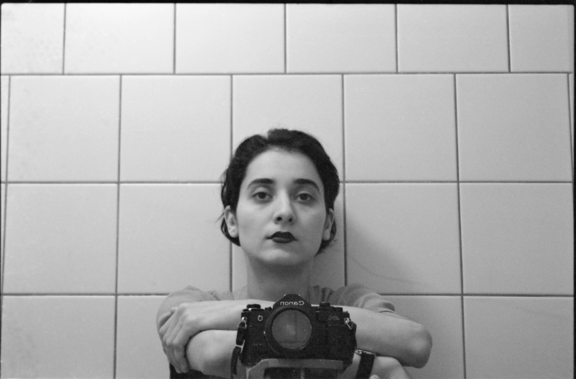 Aurora Király, Melancholia (Selfportrait with camera), Stuttgart, 1998